The French master’s entire production of portraits deserves a separate chapter.
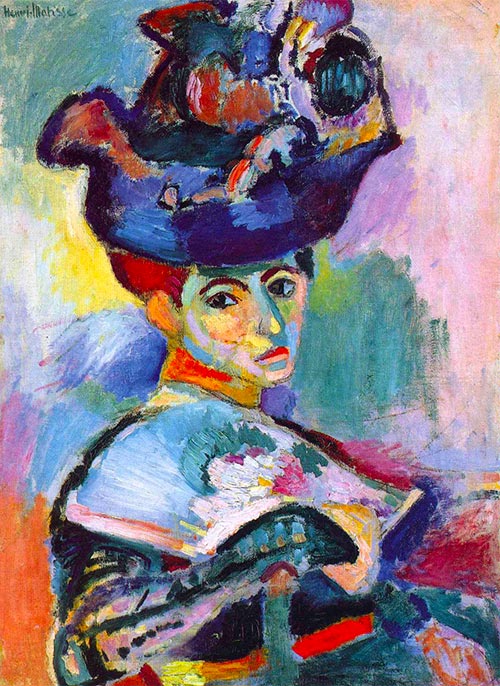
Matisse’s Woman with a Hat was exhibited, along with nine other works by the artist, at the Salon d’Automne in 1905.
The set of colors, barely justified by the form they give life to, seemed to a critic who visited the exhibition “a pot of colors tipped in the face of the public.”
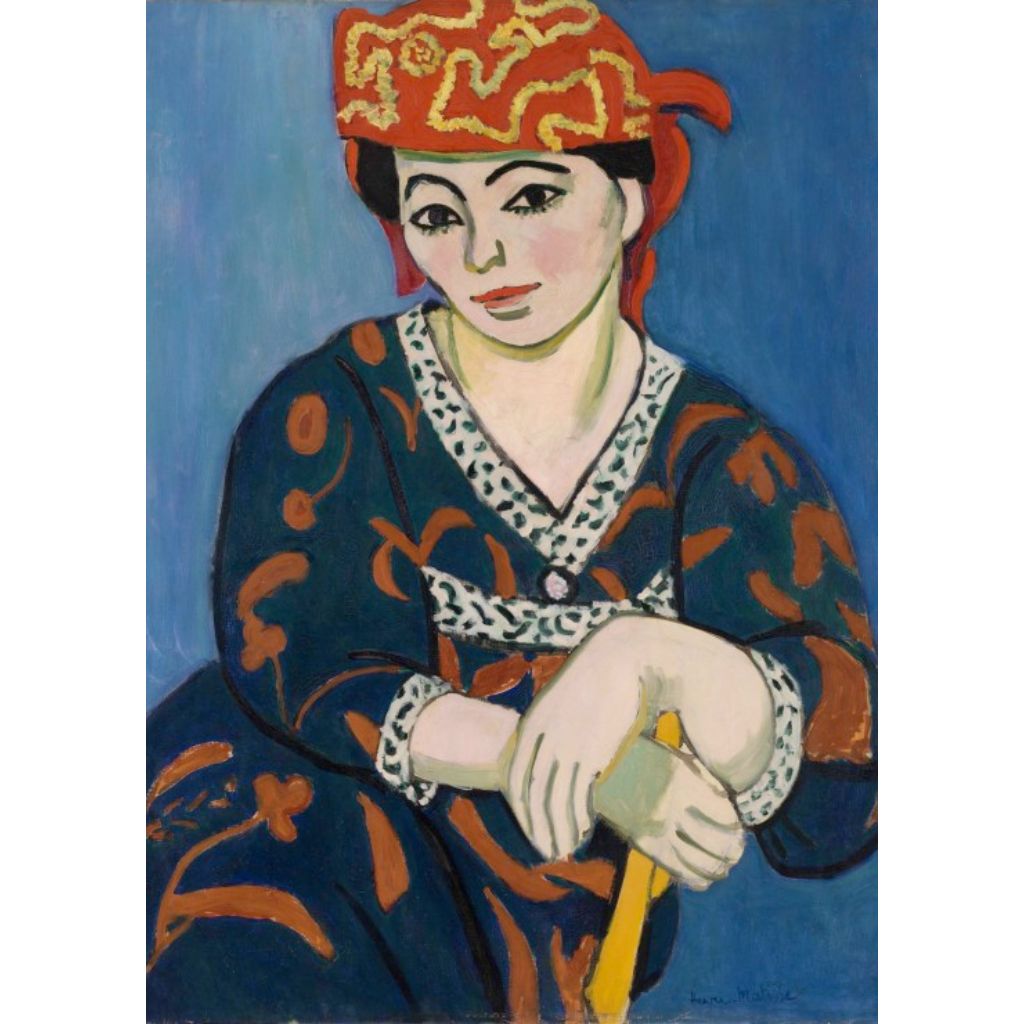
The woman, in three-quarter view, turns her gaze towards the observer, showing herself in her refined and overabundant bourgeois clothing dominated by a sumptuous and monumental hat.
The violence of the colors is the way the artist uses to assert himself and his personality.
Colors are used both pure and in combination with others. In particular, yellows are paired with violet, red with green, and blue with orange, in a mutually reinforcing complementarity. Furthermore, the primary colors themselves are arranged side by side.
The spaces on the canvas
Unlike Van Gogh and Gauguin , for whom the colours they used were an exaltation of those already present in the subject represented, Matisse does not seek objective chromatic similarity.
However, each color has a specific function in shaping the body and creating shadows. Those on the face, for example, are green, while those on the neck are orange.
The paint is distributed forcefully across the canvas, yet with such immediacy that it doesn’t completely cover it. Indeed, large unpainted spaces on the surface emerge here and there, becoming elements of the composition themselves.
Matisse’s simplification
Over time, Matisse ‘s research focused on further simplification of forms, chromatic essentiality, the use of contrasting shades and rhythmic, ornamental lines.
For Matisse, drawing is not an exercise of particular skill, a means of expressing intimate feelings and describing moods. The French master’s works are simplified means of giving greater simplicity and spontaneity to expression , which must reach the viewer’s spirit without heaviness.
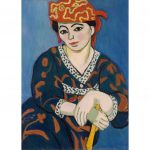
Ultimately, painting itself becomes for Matisse a sort of highly expressive drawing, colored in broad and often bright fields. This is the case of Lady in Blue .










Reviews
There are no reviews yet.