

| Numero pezzi | |
|---|---|
| Marca | |
| Atmosfera | |
| Artista | |
| Occasione | |
| Museo d'arte | |
| Dimensioni dell'opera | 220 cm × 389 cm |
| Difficoltà | |
| Dimensioni puzzle | 63.5 cm x 63.5 cm |
| Dimensioni scatola | 33 x 25 x 5 cm |
| EAN | 9781087502410 |
5 motivi per acquistare i nostri puzzle d'arte





21,90€
21,90€
Out of stock
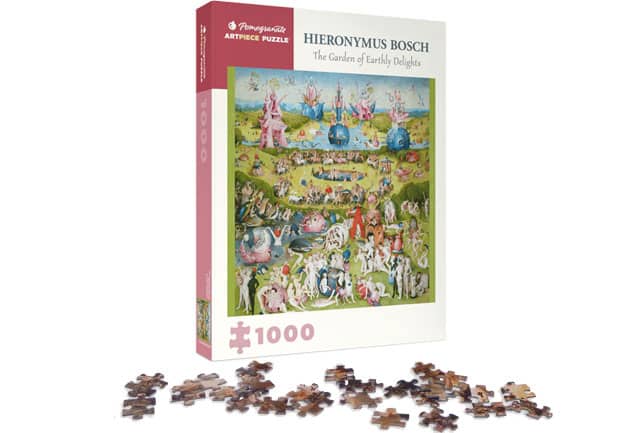
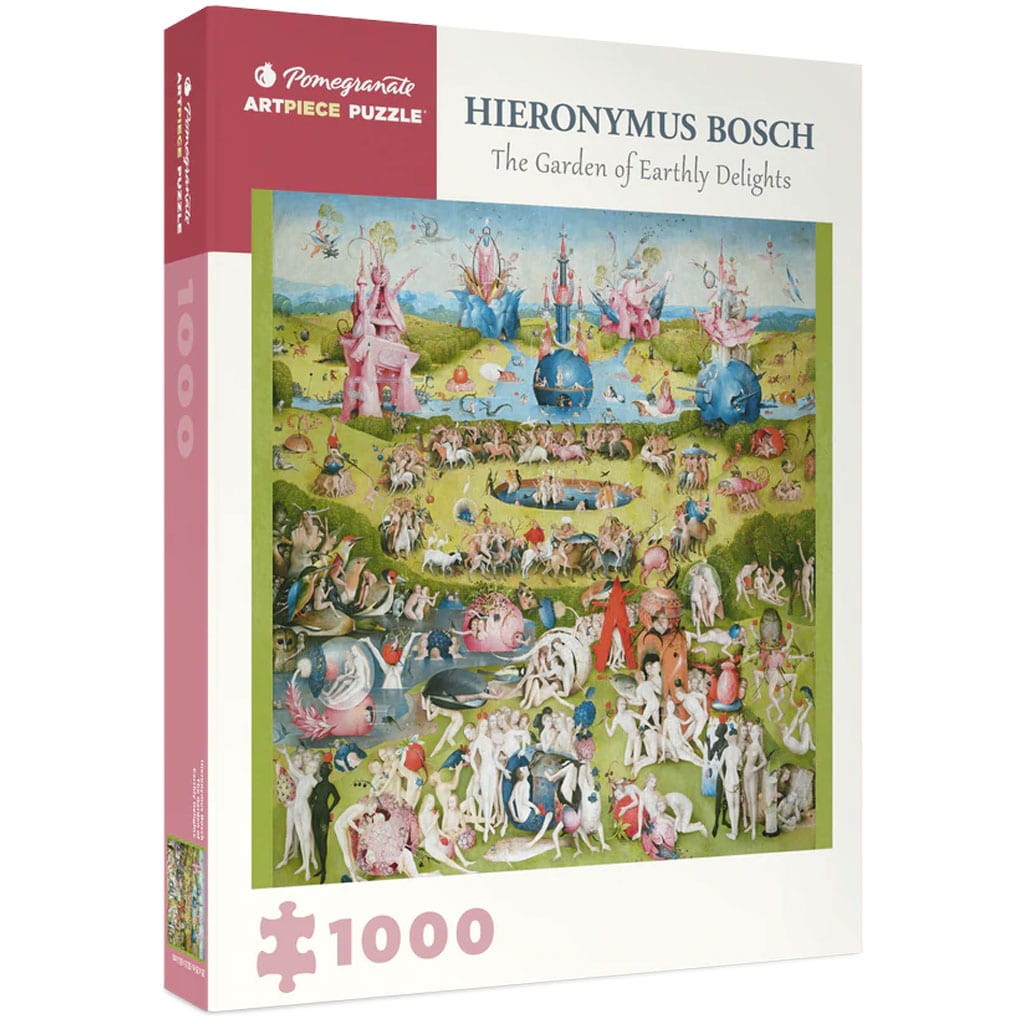
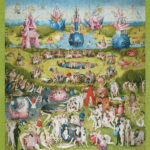
Discover the wonderful Bosch puzzle “The Garden of Earthly Delights” by assembling one of the greatest paintings by the great Dutch master Hieronymus Bosch. Thanks to this magnificent art puzzle , you’ll discover, piece by piece, one of the most fascinating works of art of the fifteenth century. Indeed, in no other work did Bosch achieve such a level of complexity, both in terms of symbolic meaning and vivid imagination.
Enjoy your puzzles with this beautiful, high-quality 1000-piece art puzzle from the American brand Pomegranate !
Questo puzzle è momentaneamente esaurito.
Nel frattempo, ti suggeriamo alcuni puzzle d’arte che potrebbero piacerti!

The Bosch puzzle, “The Garden of Earthly Delights,” is one of the most famous paintings by the great Flemish master Hieronymus Bosch. This magnificent Dutch art puzzle allows you to discover, piece by piece, the artist’s most ambitious work. In no other work did Bosch achieve such a level of complexity, both in terms of symbolism and vivid imagination.
The Garden of Earthly Delights is a large oil on panel triptych measuring 220cm x 389cm by the Dutch painter Hieronymus Bosch, datable to 1480-1490 and preserved in the Museo del Prado in Madrid .
The Bosch Puzzle The Garden of Earthly Delights by Hieronymus Bosch is one of the greatest examples of Flemish Renaissance art
In fact, the Bosch puzzle in question is one of the best-known subjects in the history of art, due to its compositional complexity and the great symbolic value of the subjects.
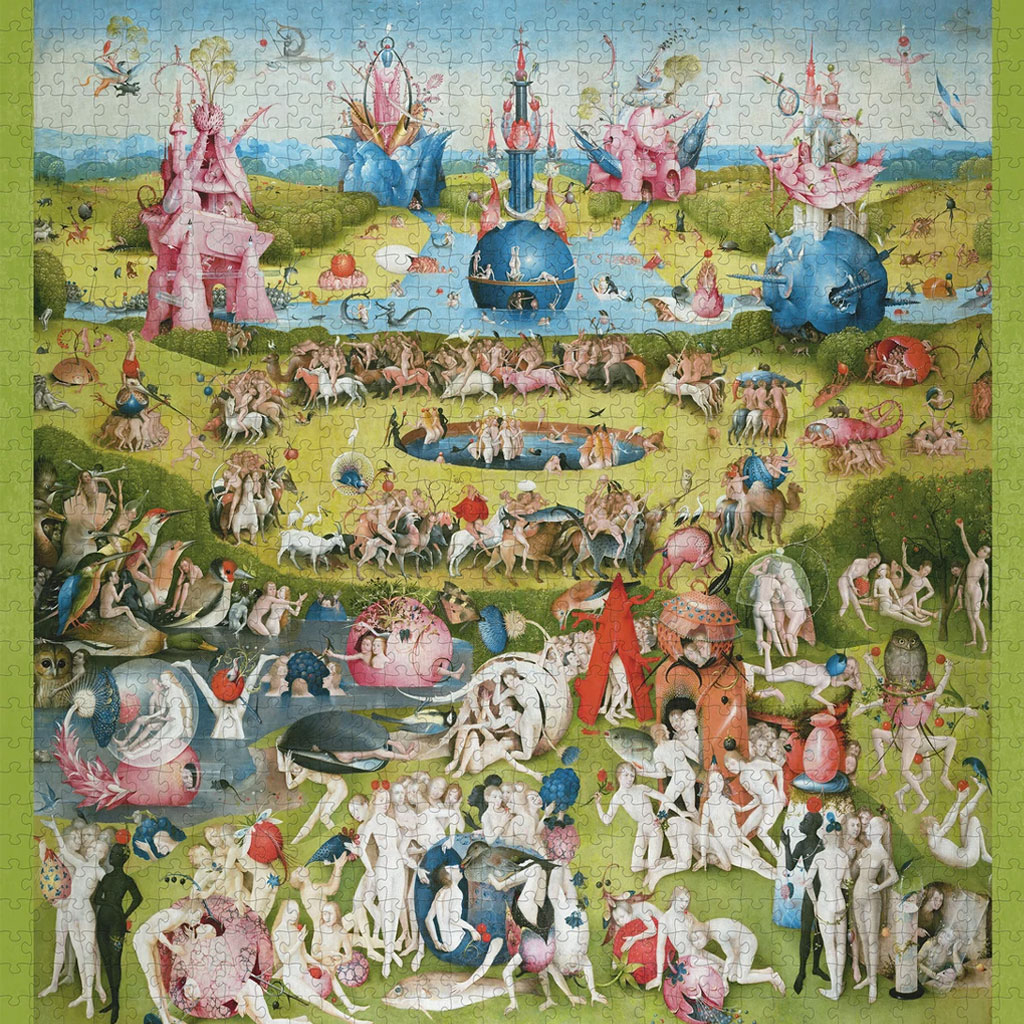
The lines of the Bosch puzzle are clear, the colors bright , and the details accurate and refined. The puzzle pieces are sturdy and the interlocking is of excellent quality .
 | Number of pieces 1000 |  | Brand Pomegranate |
 | Puzzle dimensions (cm) 63.5 x 63.5 |  | Box dimensions (cm) 33 x 25 x 5 |
Well finished box
Wonderful gift idea
Original work
Bright colors
1000 pieces
Standard grid
Hieronymus Bosch ‘s famous painting is considered a representation of carnal pleasures and, at the same time, a critique of their abuse. The Garden of Earthly Delights depicts many terrifying animal species and hybrids.
Although the triptych, now housed in the Prado Museum , is unsigned, its attribution to Bosch has never been questioned. The dating of the work, however, is the subject of considerable debate.
The overarching theme of The Garden of Earthly Delights is the destiny of humanity. To analyze the meaning of the work, it is necessary to identify the content of each panel. On the outer panels of the triptych, Bosch depicts in grisaille the Third Day of the Creation of the World, when the waters were separated from the land and the Earthly Paradise was created. On the inner panels of the triptych, painted in bright colors that contrast with the grisaille, the artist depicted three scenes that share the theme of sin.
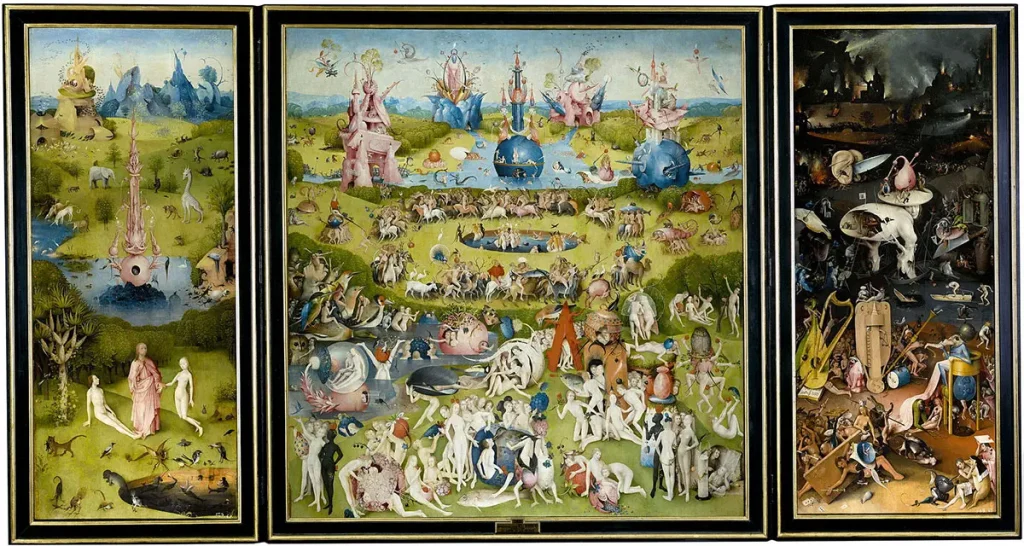

In the left panel, against the backdrop of a lush earthly paradise populated by splendid creatures, God presents Eve to Adam. Having just awoken from sleep, Adam gazes at his companion, conceived from one of his ribs, with an expression of genuine surprise. God is depicted younger than usual, more closely resembling images of Jesus. The scene teems with animals, including real creatures such as giraffes, elephants, hares, monkeys, and so on, as well as fictional creatures such as the unicorn.
The plants present are a wide variety, and a curious tree behind Adam, known as the “dracena,” will surely catch your eye. The name may not be familiar, but the shrub version of this tree is actually called the “lucky trunk” and is very common in living rooms and offices as a houseplant. At the center of this fantastic landscape, rich in fauna and flora, we finally see a pond from which a splendid fountain of life emerges.
The central section of the triptych depicts a false paradise that deceives the senses, a garden of delights dedicated to sin and lust. Here, Bosch included a large number of nude human figures, with the exception of the couple at the bottom right, identified as Adam and Eve after their expulsion from Paradise. Men and women are divided into groups or couples, engaged in various kinds of love affairs. The artist places a group of young women at the center of a large park, surrounded by a large circle of horsemen rotating counterclockwise. In the foreground, a group of naked men and women are amusing themselves, enjoying the presence of birds, plants, and companions of the opposite sex.
The animals depicted are much larger than life, and among them Bosch particularly emphasizes two different types of owls that evoke evil. These birds, at the two extreme sides of the panel, direct their disturbing gazes toward us. Plants and fruit are also present, depicted much larger than life, with erotic connotations and allegorical references to the sexual organs. In contrast to the chaos that prevails in the foreground, geometry prevails in the background, through fantastical architectural constructions. We see fountains and pavilions surrounding a lake that extends to the horizon, while to the right and left, mysterious winged figures take flight.
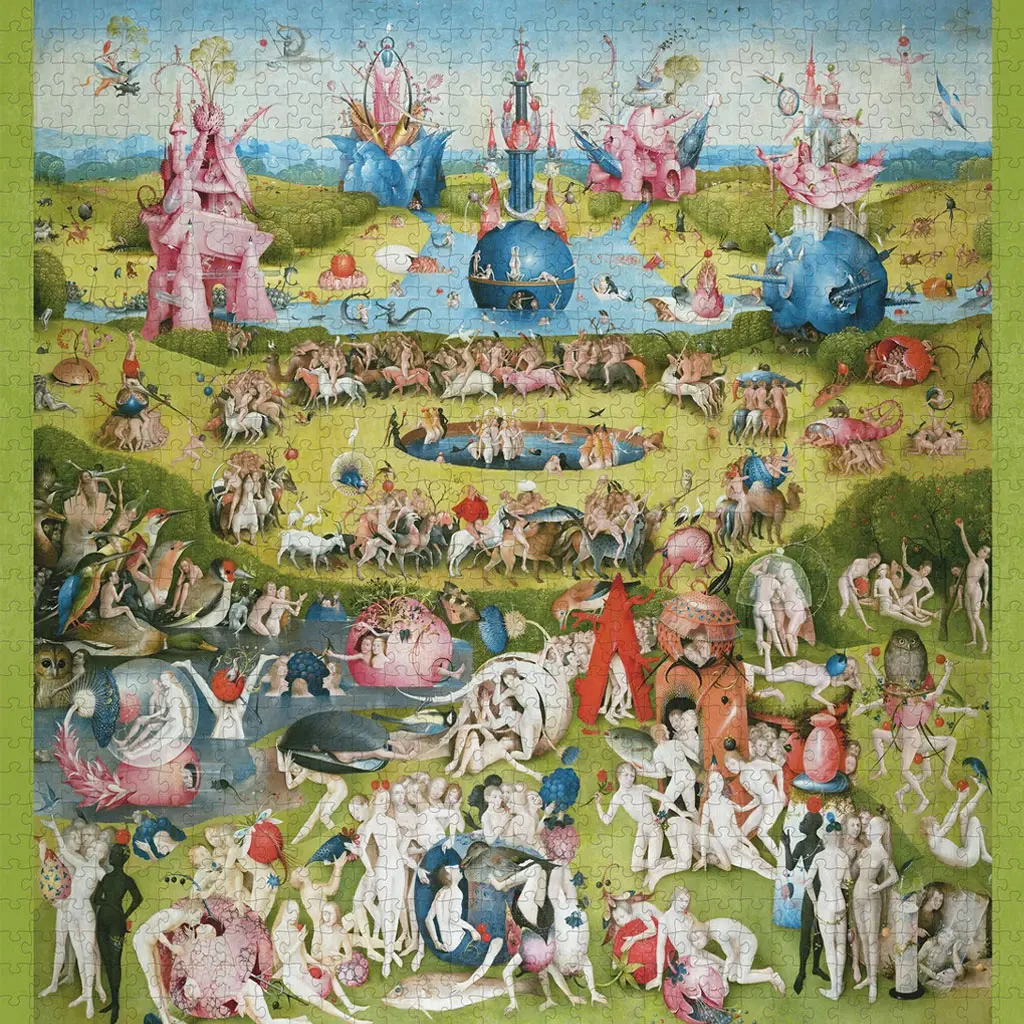
The right panel depicts a musical hell, featuring the instruments used to torture sinners who devoted their time to profane music. All the deadly sins are punished here. The miserly are devoured and immediately expelled from the anus of a bird-headed creature sitting on a sort of toilet throne. Gluttons are punished in the tavern at the center of the painting, located inside the tree-man, awaiting service by toads, devils, and other unpleasant creatures. The envious, on the other hand, are tortured by immersion in icy water.
The curious tavern-man in the center of the panel has an egg-shaped torso, a lower body made of rotting tree trunks, and feet resting on boats. In this section of the triptych, Bosch depicts the transformation of man into beast as a deserved punishment for vice and depravity. Here, the painter focuses more deeply than ever on the punishments of sinners, reaching a pinnacle in pictorial depictions of the most disgusting and disturbing things. In short, a truly infernal jumble that still inspires fear and fascination today.
On the back of the doors, visible only when the triptych is closed, Bosch painted the creation of the world, enclosed in a crystalline globe and seen as the third day of creation described in the book of Genesis, when the waters were separated from the earth. This image is created using the “grisaille” technique, which uses only shades of gray, creating monochrome paintings. The three scenes painted on the inside of the Garden of Earthly Delights Triptych, the one normally on public display, have given rise to a wide variety of, even absurd, theories. How can we explain the images depicted? The most credible and reasonable view identifies sin as the common thread running through the three panels. In short, we can say that the entire work is a sermon against the pleasures of the flesh and depicts humanity as lost in sin.
The work moves from the birth of original sin on the left to the end of sin punished in hell on the right, passing through the central panel dominated by lust. Given the many details and often indecipherable allegories, we are led to believe that this triptych was not intended for a church, where it would have been displayed to the people, but for a secular and intellectual patron. Unfortunately, we know neither the patron nor the tribulations that brought the work to Spain, to the collection of the Escorial in 1595, and then more recently to the Prado Museum, where it is exhibited today. The Garden of Earthly Delights Triptych is not in good condition. Excessive cleaning has dulled many details and figures, but despite this, its overall vision is still astonishing.
Faced with works like this, we are led to think, how far can the human imagination go? In the Garden of Earthly Delights Triptych, Hieronymus Bosch mixes popular traditions and biblical quotations, devils and paradises, nightmares and dwarves, mythological beings and fantastic animals. Indeed, everything intersects and blends, creating an unprecedented visual universe. And even though we modern people, for the most part, are no longer conditioned by superstitions, morals, and legends, we remain enraptured by what the brush of a painter who never left his small Northern European town was capable of producing.
Complimenti!
hai una vera passione per l'arte!
Visto che sei arrivato fino a qui, meriti un premio!
Ecco uno sconto del 10% per il tuo prossimo capolavoro! ✨
19,99€ – 45,00€Price range: 19,99€ through 45,00€
 Hot
Hot


Reviews
There are no reviews yet.