

| Numero pezzi | |
|---|---|
| Marca | |
| Atmosfera | |
| Formato | |
| Occasione | |
| Artista | |
| Difficoltà | |
| Museo d'arte | |
| Dimensioni dell'opera | 118 cm × 161 cm |
5 motivi per acquistare i nostri puzzle d'arte





19,99€ – 45,00€Price range: 19,99€ through 45,00€
19,99€ – 45,00€Price range: 19,99€ through 45,00€
Discover the work Bruegel Children’s Games by Doing a Puzzle, one of the greatest paintings by the great master of Flemish Renaissance art .
By putting together this magnificent Renaissance art puzzle, you will be able to discover piece by piece one of the most fascinating works of Flemish art of the sixteenth century.
Questo puzzle è momentaneamente esaurito.
Nel frattempo, ti suggeriamo alcuni puzzle d’arte che potrebbero piacerti!
Bruegel’s work Children’s Games Puzzle is one of the greatest examples of Flemish Renaissance art.
The Brueghel puzzle in question is one of the most famous subjects in the history of art because its subject matter captures the daily life of sixteenth-century children.
This is why Brueghel’s Children’s Games puzzle is suitable for both passionate puzzlers and beginners. The clearly defined design and game scenes allow you to complete this puzzle with complete peace of mind and share this moment with your loved ones while having fun.
 | Number of pieces 1000 |  | Brand D-Toys |
 | Puzzle dimensions (cm) 68 x 47 |  | Box dimensions (cm) 38 x 26.5 x 5.5 |
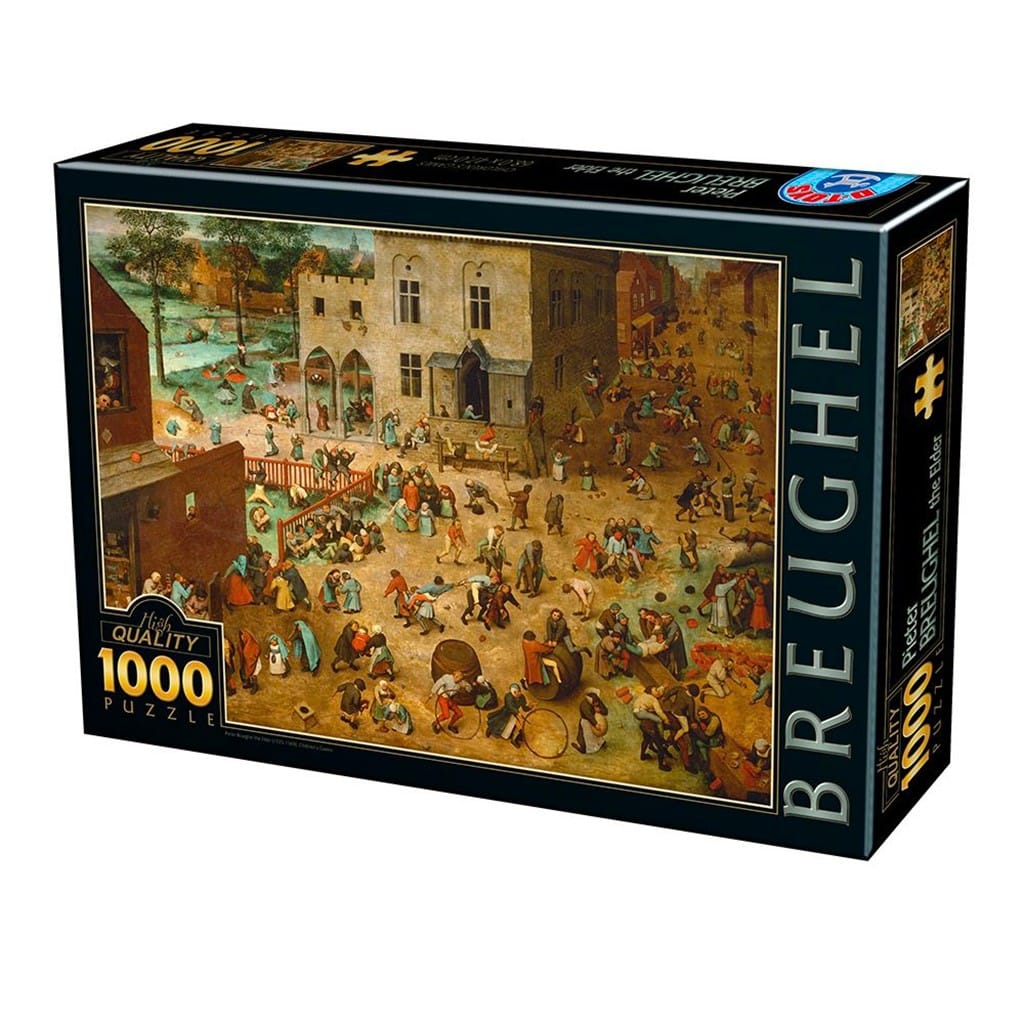
Well finished box
bright colors
Famous work of art
best-selling puzzle
1000 piece puzzle
Standard grid
Bruegel’s work Children’s Games is one of the greatest examples of Flemish Renaissance art.
The Bruegel Children’s Games puzzle in question is one of the most famous subjects in the history of art because its subject matter captures the daily life of sixteenth-century children.
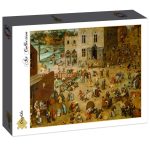
This 2000-piece puzzle is especially suitable for passionate and experienced puzzle makers. The well-defined design and the game scenes allow you to complete this puzzle with complete peace of mind and share this moment with your loved ones while having fun.
| Number of pieces 2000 | | Brand Grafika |
| Puzzle dimensions (cm) 98 x 69 | | Box dimensions (cm) 33 x 25 x 7 |
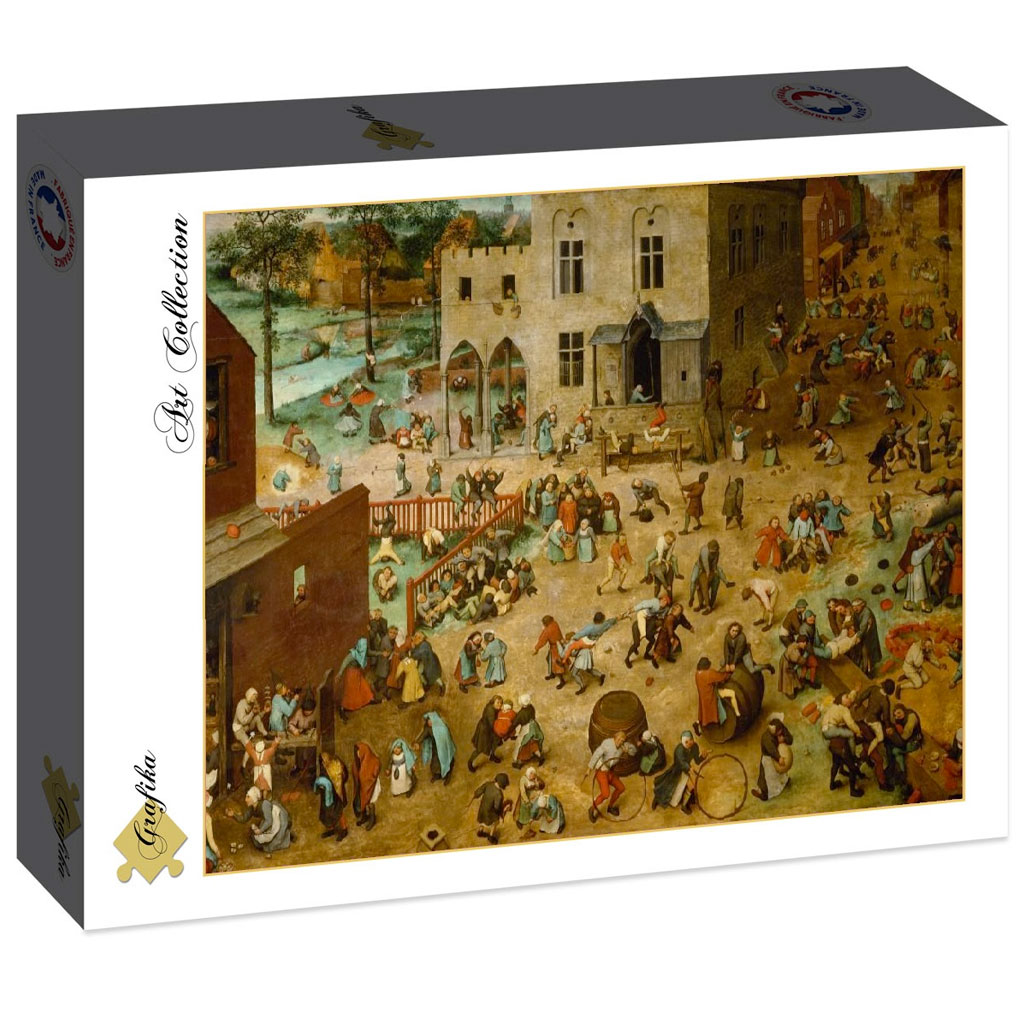
Elegant box
colors faithful to the original
Famous work of art
Renaissance art
2000 piece puzzle
Standard grid
The work Bruegel Children’s Games in puzzle version is our choice for discovering and entering the art of the great Dutch artist Pieter Jan Brueghel the Elder.
The painting Children’s Games is a medium-sized oil on panel painting (118 cm x 161 cm) by Pieter Bruegel the Elder, dated 1560 and preserved in the Kunsthistorisches Museum in Vienna.
The dating is made possible by the date and the signature that the author places at the bottom right “ BRVEGEL 1560 ″.
This work, mentioned by van Mander in 1604, was purchased in 1594 by Archduke Ernest of Habsburg, entering the private collection of the Habsburg family.
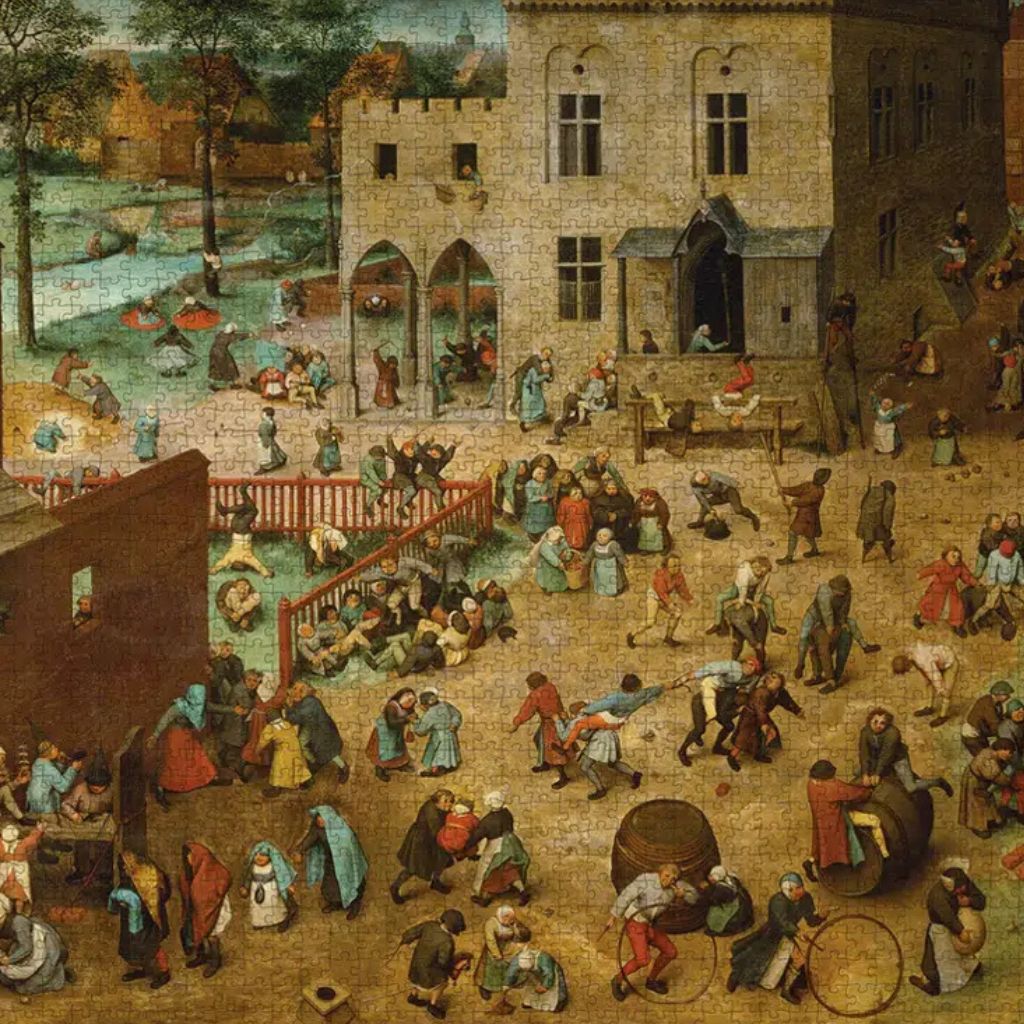
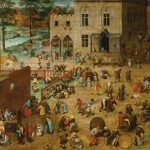
The scene of the work depicts a large square that welcomes groups of children , intent on playing with expressions halfway between monotony and flatness.
In fact, Children’s Games, the work of Bruegel the Elder, is a very useful document on how adults and children spent their free time in the mid-sixteenth century.
More than eighty typical sixteenth-century games are represented in the painting .
Thanks to this sort of photography we are, therefore, able to understand how the people who lived in 1560 spent their time.
From the painting, it is easy to recognize, among others, games such as “ blind man’s buff ”, “ piñata ”, “ morra ”, “ pass the barrel ”.
For example, we find “Toton,” the ancestor of roulette. Known since ancient Roman times, toton takes its name from the Latin totum (“all”) because it was used for gambling. The game consists of a die mounted on a stick that is rotated after placing a bet.
We can consider classic throwing games, such as throwing hats through a child’s outstretched legs, competing to see who can throw them the farthest. Or throwing coins against a wall, where the winner is the one who manages to place the coin closest to the wall.
We can also find the Knucklebones game of very ancient origins, played with five small objects, originally the “knuckles” of a sheep, which are thrown and caught.
The bustling view of a village square hosts groups of children performing childhood games.
The subject, already practiced in medieval miniatures, is here brought together in a single scene for the first time. The view is achieved through the geometric application of fifteenth-century perspective, populated by groups of figures and individual characters, evenly spaced, with a zoned organization facilitated by the presence of colored patches on the ground, sometimes dusty, sometimes muddy, sometimes grassy, in full light or in shadow.
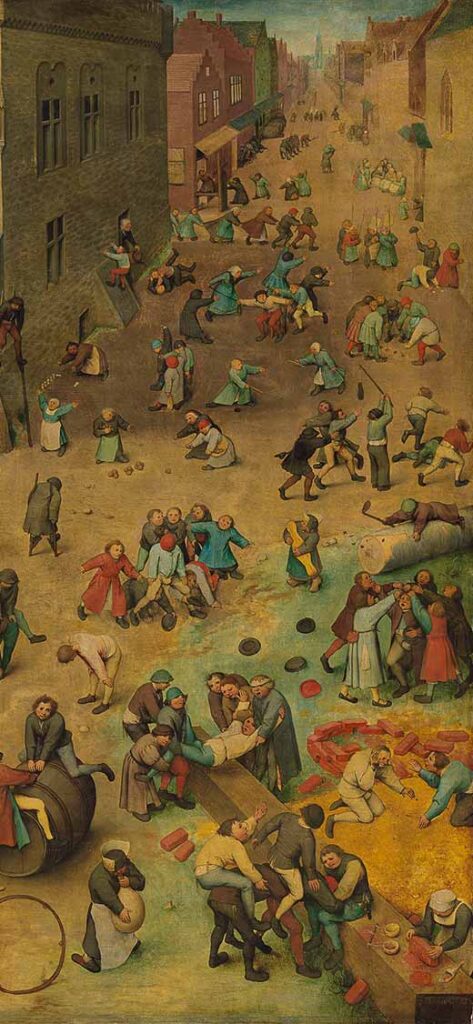
The simple Roll Hoop is a game that children and adults all over the world have always played.
From simple wooden hoops to bicycle rims, throughout history everyone has played with hoops, twirling, rolling and throwing them.
Furthermore, already 500 years ago we can find the game of soap bubbles still a popular pastime, Bruegel shows children blowing bubbles with clay tubes.
The piñata , a very popular game, has its roots in ancient history. It’s a papier-mâché or other container that’s decorated, filled with toys and/or candy, and then broken, usually as part of a ceremony or celebration.
The game of bowls , spinning tops, hide and seek and the first balloons made with an inflated pig bladder.
The artist’s intention for this work is more serious than simply compiling an illustrated encyclopedia of children’s games , although some eighty particular games have been identified.
The details that Bruegel shows in children absorbed in their games with the seriousness shown by adults in their seemingly more important activities.
Its moral is that in God’s mind, children’s games have as much meaning as their parents’ activities . This idea was familiar in contemporary literature: in an anonymous Flemish poem published in Antwerp in 1530 by Jan van Doesborch, humanity is compared to children who are completely absorbed in their games and their silly worries.
The left side of the painting, where beyond a red-walled house one can see a garden and, further away, an oasis on the banks of a river, offers a point of rest and repose for the observer’s mind, with the very pleasant view of the distant houses of the village.
Show reviews in all languages (1)
Complimenti!
hai una vera passione per l'arte!
Visto che sei arrivato fino a qui, meriti un premio!
Ecco uno sconto del 10% per il tuo prossimo capolavoro! ✨
25,00€
19,90€ – 39,99€Price range: 19,90€ through 39,99€
 Hot
Hot

Reviews
There are no reviews yet.