

| Numero pezzi | |
|---|---|
| Marca | |
| Atmosfera | |
| Artista | |
| Occasione | |
| Museo d'arte | |
| Dimensioni dell'opera | 47.5 × 57 cm |
| Difficoltà | |
| Dimensioni puzzle | 98 x 69 cm |
| EAN | 3663384301131 |
| Movimenti artistici |
5 motivi per acquistare i nostri puzzle d'arte





 Hot
Hot
29,90€ – 45,00€Price range: 29,90€ through 45,00€
29,90€ – 45,00€Price range: 29,90€ through 45,00€
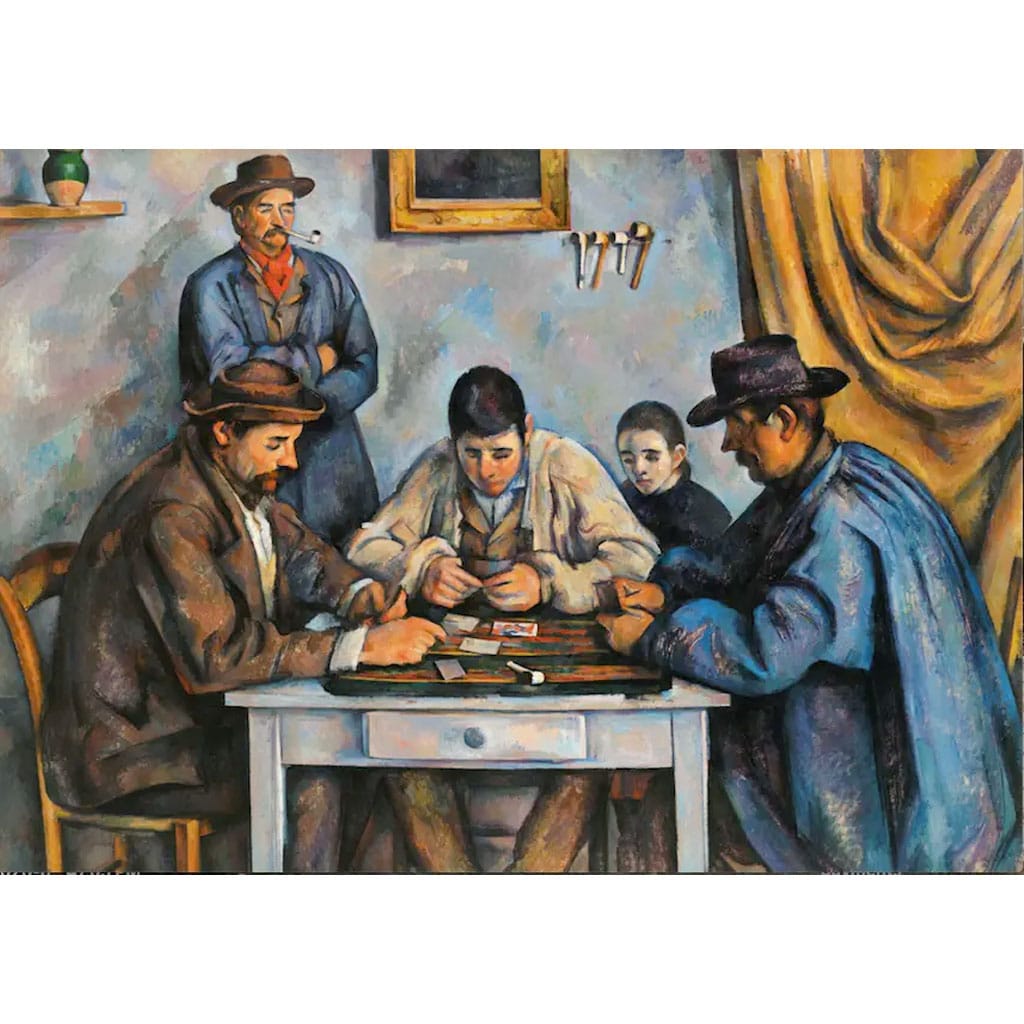
The Cézanne Card Players , created by Grafika, reproduces the iconic work by the French painter, dated between 1894 and 1895. With 2,000 pieces, it offers a compelling challenge for art and puzzle enthusiasts. Measuring 98 x 69 cm, it is designed for adults. Perfect for those who want to immerse themselves in art history while having fun reconstructing one of his most famous works.
Questo puzzle è momentaneamente esaurito.
Nel frattempo, ti suggeriamo alcuni puzzle d’arte che potrebbero piacerti!
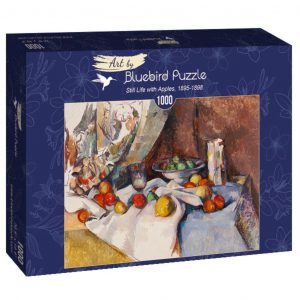
With this refined Cézanne The Card Players , belonging to the Grafika Art Collection, you have the opportunity to reconstruct one of the most emblematic masterpieces of the post-impressionist master created between 1894 and 1895.
A painting that, in its apparent simplicity, contains a silent revolution in the history of art.
A perfect puzzle for those who love atmospheric painting, deep nuances, studied composition, and the contemplative calm that great works of art convey.
The 1000-piece Paul Cézanne puzzle from Art & Fable lets you enter the magnificent world of Cézanne’s unique paintings.
This painting, created between 1890 and 1895, features a recurring theme in his painting: the card game , in which, as in this case, two characters face each other.
The puzzle’s lines are bold, the colors vibrant , and the details meticulously crafted. The puzzles are made with velvet-touch technology, which makes the surface velvety to the touch, and the interlocking pieces are of excellent quality.
 | Number of pieces 1000 |  | Brand Art & Fable |
 | Puzzle dimensions (cm) 68 x 48 |  | Box dimensions (cm) 33 x 24 x 5 |
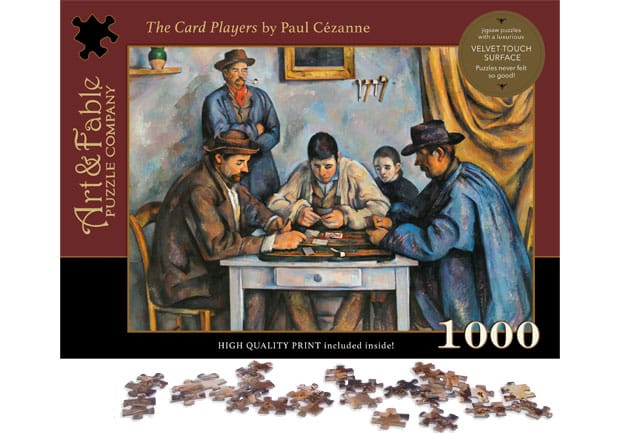
Well finished box
Wonderful gift idea
Original work
Bright colors
1000 pieces
Velvet Touch Technology
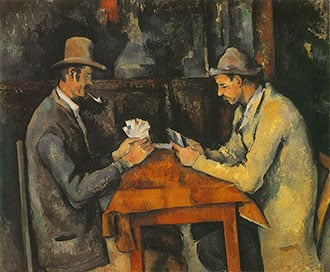
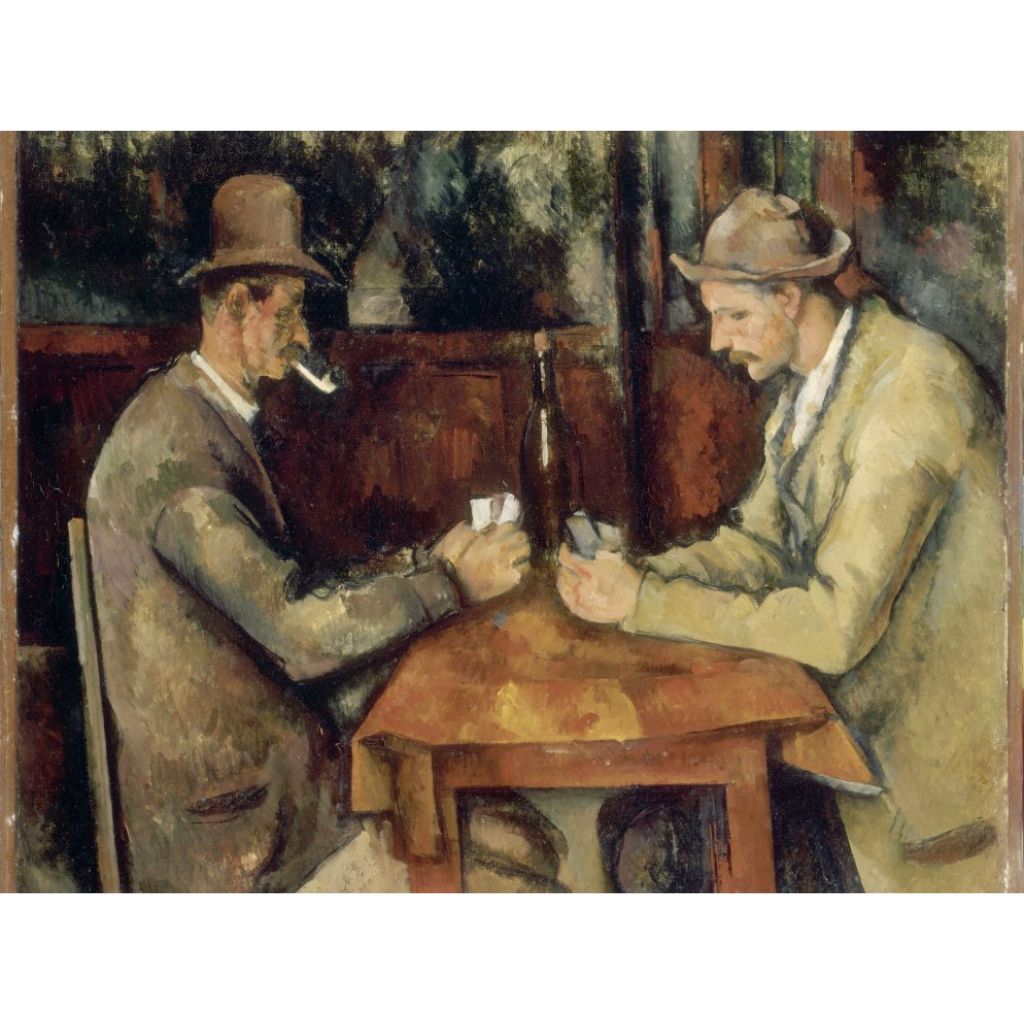
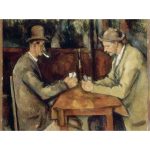
The scene portrays two men sitting opposite each other at a table, engrossed in a game of cards .
The silence between them is dense, almost tangible. Their expressions are concentrated, their movements still .
Around, the world seems to disappear, leaving only the geometry of the scene, the bottle in the center as a vertical axis and the earthy tones that envelop the protagonists.
| Number of pieces 2000 | | Brand Grafika |
| Puzzle dimensions (cm) 98 x 69 | | Box dimensions (cm) 38 x 27 x 7 |
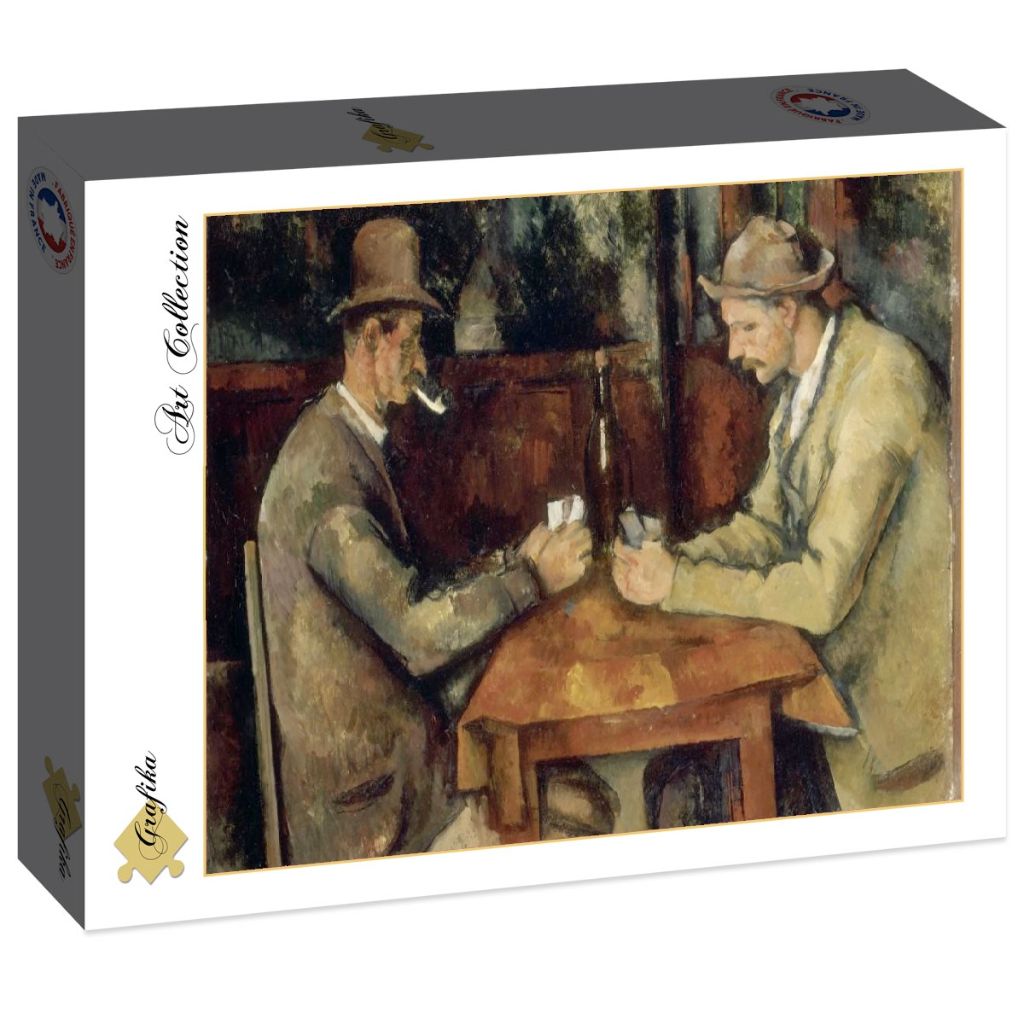
Well finished box
Wonderful gift idea
Famous art subject
Elegant painting
2000 pieces
Standard grid
The Card Players by Cézanne is one of the most famous works by the French master, and is part of a series of five versions that the artist created on the same theme.
This version, created between 1894 and 1895, is considered one of the most balanced and intense.
Cézanne doesn’t seek the spectacularity of the scene, but explores its internal structure. The players almost become statues , monuments of concentration.
Play is not just a pastime: it is a ritual , a silent dialogue, a human confrontation .
The vertical bottle in the center of the table divides and unites the two characters, becoming an architectural element in a rigorous and thoughtful composition.
With this series, Cézanne continues his exploration of space, form, and the relationship between figures and objects. It is a foretaste of what Cubism will be, but also a profound exploration of the human condition.
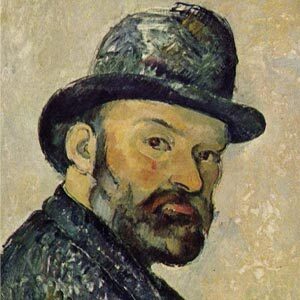
Paul Cézanne (1839–1906), considered the precursor of modern art , led painting from Impressionism to Cubism.
With his personal language and his constant search for balance between form and color, Cézanne influenced entire generations of artists, including Picasso and Matisse.
His art is made of observation , geometry , meditation .
His compositions, even the simplest ones like a game of cards, become profound visual studies of reality and how the eye and mind perceive it.
The Card Players is one of the silent manifestos of this poetics: an everyday scene transformed into a timeless icon.
His painting aimed to reach the ultimate essence of the subject represented, through a constant study that was not only emotional, but also mathematical and rational. The color in his works is sometimes dense and material, creating actual construction lines, at other times so rarefied as to resemble watercolor. The synthesis of line and color in his works gave rise to geometric architectures and solid volumes. His work, so distant from the pictorial experiments of his time, inspired artists such as Georges Braque and Pablo Picasso .
Cézanne had something obsessive about creating his paintings: version after version of the same subject, sometimes changing a spatial detail, sometimes modifying a color tone, until he reached a deeper analysis of the scene depicted. The subject of the card players is no exception, repeated in five different variations where the perspective radically changes, increasingly focusing on the players’ action and the moment when one of the two will play the winning card, ending the game.
In this painting, the atmosphere is heavy; the two men don’t speak, intent as they are on their game. Their massive bodies face each other in a silence that seems to spread throughout the room.
The figures are perhaps familiar to Cézanne , who often visited his father’s country house, where he could peacefully observe scenes like this. The choice of colors and the way the light is distributed give the painting a sense of melancholy and sadness.
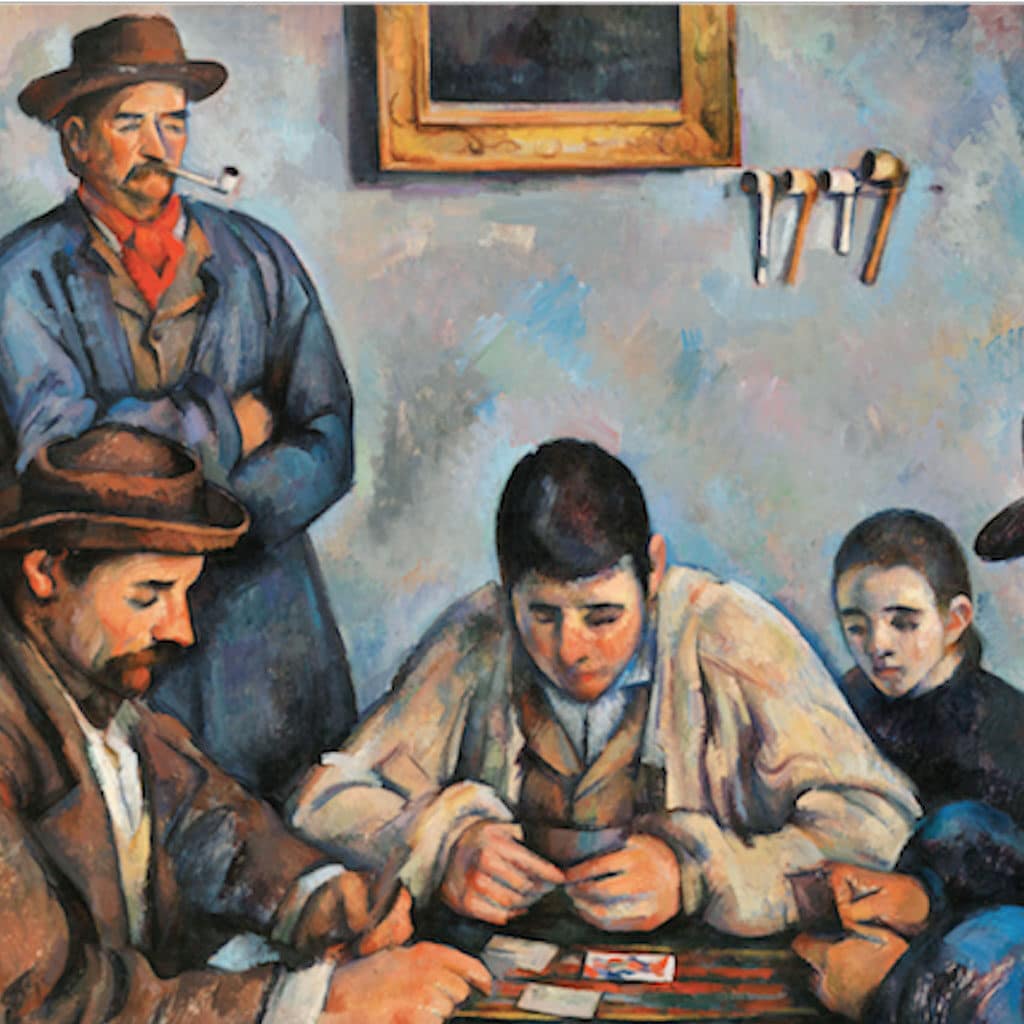
Paul Cézanne created five paintings with the same theme , and the version held at the Musée d’Orsay is the one with the most sober colors and highlights the artist’s stylistic research .
A painting titled The Card Players is exhibited at the Aix-en-Provence museum and was owned by the Le Nain brothers . Some even claim that it was they who inspired Cézanne to paint the painting.
In the work, the figures in the scene were constructed by the artist by simplifying the shapes . In fact, the torso of the card player on the left, his arms and his hat seem to take on a cylindrical shape , the table that of a parallelepiped and the bent arms of the players instead seem to form triangles .
It is evident that Cézanne executed the work in a completely rational way, with a research that is defined as Post-Impressionist , which anticipated and strongly influenced the birth of Cubism .
The painter had no particular preference for the subject; it was simply dictated by his own habit of frequenting bistros, as many other artists in Paris did at the time. Indeed, it was precisely at the tables of these establishments that the social and cultural life of the French capital came to life, with patrons entertaining themselves by playing cards, drinking, and even dancing.
Complimenti!
hai una vera passione per l'arte!
Visto che sei arrivato fino a qui, meriti un premio!
Ecco uno sconto del 10% per il tuo prossimo capolavoro! ✨
29,90€ – 55,00€Price range: 29,90€ through 55,00€
25,00€
49,90€


Reviews
There are no reviews yet.